
I
The heat of September in Columbus did not fade like a gentleman; it clung to the brick storefronts like a damp wool coat. Inside the narrow repair shop, the air smelled of valve oil, scorched solder, and thirty years of accumulated dust that settled on every surface in a fine, gray shroud. Arthur Turner did not mind the dust. It was honest. It stayed where it fell and never asked for a solo.
He sat on a low-backed wooden stool with a jeweler’s loupe pressed to his left eye, his thumbs working a vintage Bach Stradivarius bell with the delicate concentration of a clockmaker. Outside, tires hissed against the asphalt of Parsons Avenue as a late afternoon drizzle began to turn the street slick and dark. Arthur did not look up when the heavy oak door chimed, though he knew the sound well enough to tell whether a customer was browsing or desperate.
"We're closed for restoration drop-offs," Arthur said, his voice like dry leaves scraping across concrete. "Pick-ups are Thursdays only."
"I'm not here to pick up a horn, Grandfather," a voice replied.
Arthur froze. The loupe slipped from his eye socket, catching the edge of his workbench before bouncing softly onto a rag. He raised his head, blinking against the sudden clarity of the unmagnified room. Standing just inside the threshold, shaking out a red umbrella with sharp, impatient snaps, was Maya. She wore a tailored charcoal blazer that looked entirely out of place among the shelves of corroded mouthpieces and spare valve caps, her dreadlocks gathered high in a silver clasp.
They had not spoken in four years—not since the funeral in Cincinnati, not since the bitter afternoon Maya packed her trunk for Chicago and told him that his silence was a louder instrument than any trumpet he had ever played.
"You're out of uniform," Arthur muttered, breaking the silence first. He reached for a yellowed shop rag and wiped his grease-stained knuckles. "Chicago law firms don't close on account of a drizzle, do they?"
"Corporate restructuring gives us a bit of leeway," Maya said, stepping further into the cramped aisle. She looked around, her eyes lingering on the pegboard of rusted tuning slides and the framed, yellowed photograph of Arthur's old quintet from 1974. "Nice place. Very... aromatic."
"It pays the property tax and keeps my hands busy." Arthur gestured vaguely to a scarred folding chair near the heater. "Sit down before you track mud on the floorboards."
II
For twenty minutes, conversation remained confined to the weather, the price of silver plating, and the general decline of downtown real estate. Maya kept her coat on, her hands tucked neatly into her pockets as if ready to retreat back into the rain at a moment's notice. Arthur kept working, his file rasping rhythmically against a stubborn brace.
The tension in the shop was not hostile; it was heavy, weighted with the unspoken history of two people who inherited the same stubborn pride and lacked the register to express affection without a fight.
Finally, Maya reached into her leather tote bag and pulled out a heavy velvet case, scuffed at the corners and smelling faintly of a damp attic. She placed it squarely in the center of the workbench, pushing aside a tin of joint compound.
"Mother passed away last month," Maya said. Her voice dropped its professional crispness, flattening into something raw and thin.
Arthur’s hand stopped mid-stroke. The file clattered onto the bench. He did not look at her; instead, his gaze fixed on the worn brass latches of the case. Clara. His only daughter, who had inherited her mother’s sharp temper and none of Arthur’s ear for pitch. They had lived three miles apart for a decade and might as well have been separated by an ocean.
"I know," Arthur said quietly. "The pastor called. I sent flowers. White lilies."
"They arrived," Maya said. She tapped the velvet case with a single manicured fingernail. "When we were clearing out her apartment in Evanston, I found this in the back of the bedroom closet, buried underneath old tax forms and winter coats. It was wrapped in your old tour jacket from the Savoy."
Arthur swallowed hard. His throat felt dry, like he had swallowed a mouthful of brass shavings. He reached out, his dark, age-spotted fingers tracing the faded velvet. He didn't need to open it to know what lived inside. The King Liberty model, silver-plated with gold wash on the inside of the bell—the horn he had hocked in the winter of '88 to pay for Clara’s braces, the horn he thought was long melted down for scrap.
"She kept it," Arthur whispered.
"She kept it," Maya agreed. "She never played a note in her life. Hated the sound of practice. But she kept it in her closet for thirty-five years."
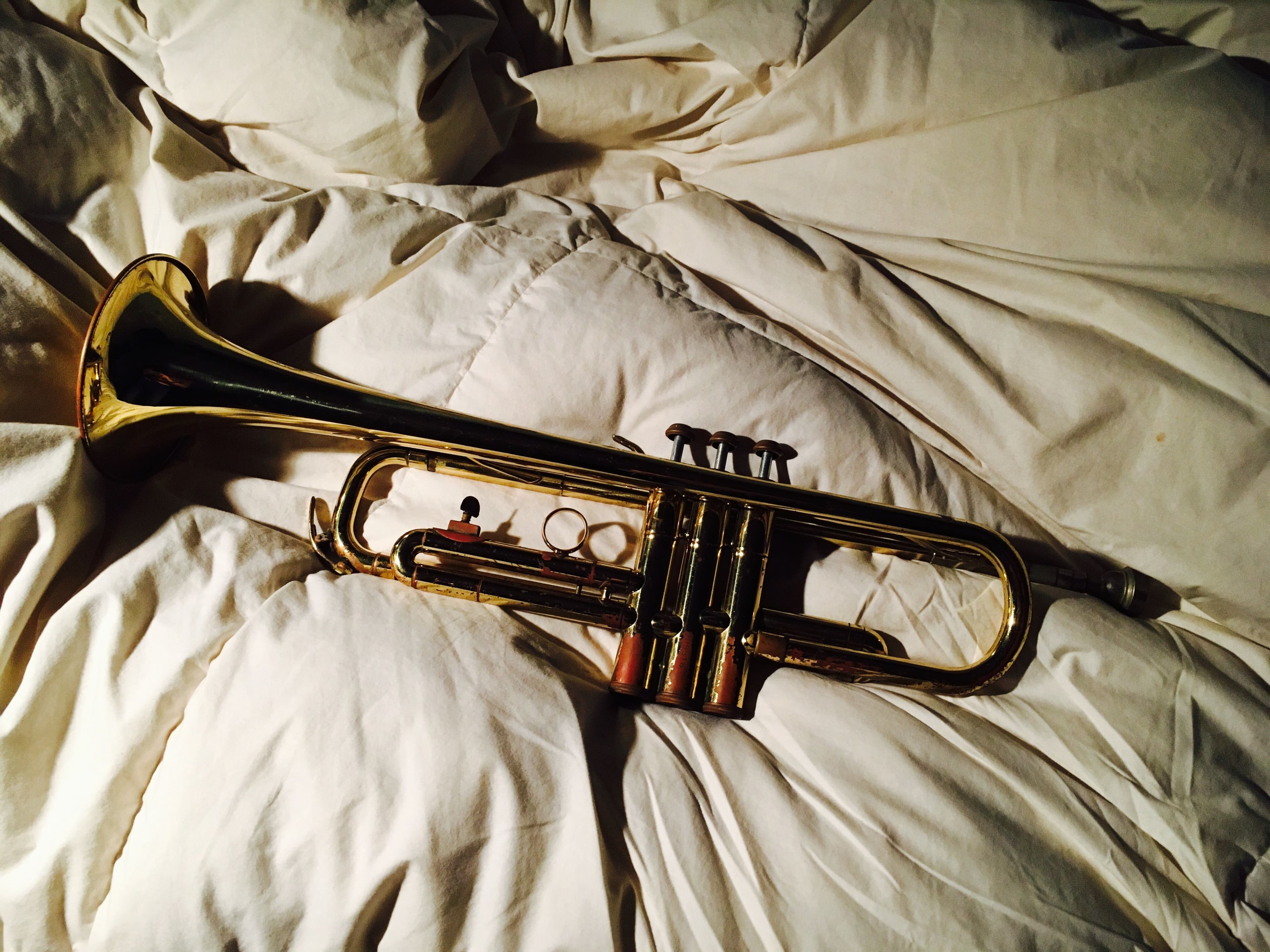
Arthur unlatched the left side, then the right. The lid creaked open. Inside, resting against faded purple plush, was the trumpet. It was tarnished nearly black, the silver oxidized into deep indigo shadows around the valve casing, but the engraving on the bell—a delicate spray of wild honeysuckle—still caught the weak fluorescent light from the ceiling fixture.
"Why did you bring it here, Maya?" Arthur asked, looking up at his granddaughter. Her eyes, the exact shape of Clara’s, were shimmering with unshed tears that she refused to let fall.
"Because," Maya said, her voice catching slightly before she steadied it, "I'm tired of things sitting in closets, Grandfather. I'm tired of people holding onto things until they rot. You're eighty-two years old, and you're sitting in this damp room fixing other people's horns while your own history turns to copper oxide."
III
The rain outside subsided into a steady, rhythmic drip from the gutter overhead. Arthur slowly lifted the King Liberty out of its case. It felt heavier than he remembered, or perhaps his wrists were simply thinner. He balanced it in his left hand, testing the valve action. They were completely gummed up with twenty years of attic dust and dried lubricant; the second valve stuck halfway down with a dry, protesting crunch.
"It's frozen solid," Arthur said.
"Then fix it," Maya said, pulling off her blazer and draping it over the folding chair. She rolled up her white silk sleeves, revealing forearms dusted with pale freckles. "You're the master craftsman, aren't you? Or have you forgotten how a horn breathes?"
Arthur let out a dry, rattling chuckle—the first real laugh he had produced in months. He reached for a bottle of penetrating oil and a small brass hammer. "Get me that jar of pumice paste from under the counter, lawyer girl. And tie that apron around your waist before you ruin your blouse."
For the next three hours, the repair shop transformed into a sanctuary of shared labor. They did not talk about the funeral, or the years of missed birthdays, or the silence that had stretched between Ohio and Illinois like an unstrung bridge. Instead, they spoke in the vernacular of the workbench.
Arthur showed her how to heat the lead solder just enough to free a stuck tuning slide without scorching the brass. Maya held the delicate tubing steady with surprising steadiness, her fingers nimble where Arthur's trembled slightly from age. They worked side by side under the harsh light of the gooseneck lamp, the air filling with the sharp, clean smells of citrus solvent, tripoli polishing compound, and warm metal.
As the clock on the wall ticked past eight, Arthur carefully unscrewed the bottom cap of the second valve. He pulled out the piston, wiped away the black, sludgy residue with a clean cloth, and inspected the port holes. The brass underneath was bright, flawless, and gleamed with a warm, reddish gold.
"Look at that," Arthur murmured, holding the piston up to the light. "Good American brass. They don't cast them like this anymore. Too much zinc in the modern ones. They sound tinny."
Maya leaned over his shoulder, her dark hair brushing against his gray sleeve. "Just needs a little care," she said softly.
"Everything does," Arthur replied.
IV
When the horn was fully reassembled, polished to a dull, honest luster that reflected the yellow shop light, Arthur set it down on a clean green felt mat. The transformation was remarkable; it looked less like an antique rescued from a tomb and more like an instrument waiting for a breath.
Arthur reached out, picked up the trumpet, and brought it to his lips. He didn't play a melody—not a standard, not a blues scale, not a fragment of the old nights at the Blue Note on Livingston Avenue. He simply blew a single, long, sustained middle C.
The note filled the small shop, bouncing off the brick walls and the shelves of sheet music, clean and resonant and entirely true. It vibrated against the window glass, cutting through the hum of the heater and the distant rush of evening traffic.
When he lowered the horn, his chest was heaving slightly, but his eyes were bright.
"You still got the wind," Maya said, her voice barely a whisper.
"The wind is the easy part," Arthur said. He laid the trumpet back in its velvet bed, but he did not snap the latches shut. He looked across the workbench at his granddaughter, taking in the tired lines around her eyes and the fierce, quiet determination in her posture. She was Clara’s daughter, yes, but she was his blood too—made of the same stubborn metal.
"I have two tickets for the Friday night set down at the Axis club," Arthur said, clearing his throat. "A kid from Cleveland is playing cornet. Supposed to have a nice tone. If corporate restructuring permits, of course."
Maya smiled, a slow, genuine curve of her mouth that chased away the last four years of cold distance. She reached out and closed the velvet case, her hand resting over the brass latches.
"Corporate restructuring," Maya said, picking up her blazer, "can wait until Monday."